

What Size Fire Skid Unit Do I Need?
Choosing the right fire skid unit starts with more than deciding how much water you want to carry. The right fire skid tank size depends on your vehicle’s capacity, available space, intended application, equipment configuration, and the total loaded weight of the skid.
A larger tank provides more water, but it also adds significant weight and takes up valuable space. A smaller unit may offer greater maneuverability or leave additional room for tools and equipment. The goal is to find a configuration that provides the firefighting capability your department or agency needs while staying within the limitations of the vehicle carrying it.
KickAshSkid offers fire skid units in multiple configurations for pickup trucks, UTVs, specialty vehicles, and other wildland firefighting applications.
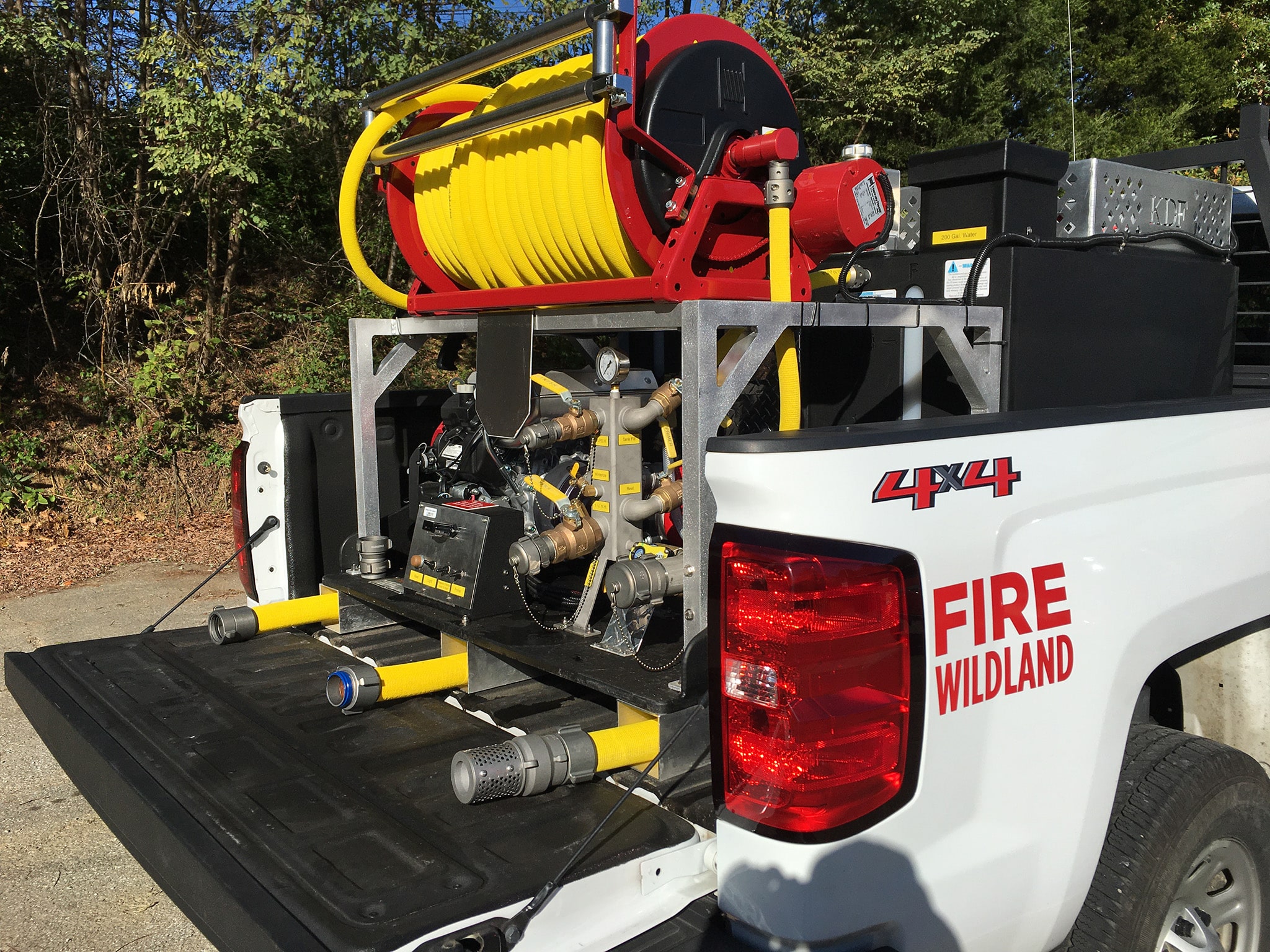
How Do You Choose the Right Fire Skid Tank Size?
Start with the vehicle.
Before deciding between a 50-, 100-, 150-, 200-, or 300-gallon tank, determine how much weight the vehicle can safely carry when fully loaded.
The total operating weight may include:
- Water
- Tank and skid structure
- Pump and engine
- Hose reel and hose
- Plumbing and hardware
- Foam equipment, when applicable
- Fuel
- Firefighting tools and equipment
- Vehicle occupants
- Additional cargo
The vehicle manufacturer’s ratings and applicable department, agency, and regulatory requirements should guide the final configuration.
Simply knowing that a tank physically fits into a truck bed or UTV does not mean the vehicle can safely carry the completed firefighting system.
How Much Does Water Weigh in a Fire Skid?
One U.S. gallon of water weighs approximately 8.3 pounds, depending slightly on temperature. That weight adds up quickly when choosing a fire skid tank.
For example, 50 gallons of water weighs approximately 415 pounds. A 100-gallon tank contains roughly 830 pounds of water, while 150 gallons is approximately 1,245 pounds.
Moving up to 200 gallons means carrying roughly 1,660 pounds of water. At 300 gallons, the water alone weighs approximately 2,490 pounds.
Those figures do not represent the complete weight of the skid unit. The tank, frame, pump, hose, reel, plumbing, fuel, hardware, tools, and other equipment all add additional weight.
That is why vehicle capacity should be one of the first considerations when choosing a fire skid.
Is a 50- to 100-Gallon Fire Skid Right for You?
Smaller-capacity fire skids can make sense when vehicle size, available payload, maneuverability, and space are important considerations.
These capacities are particularly relevant for UTVs and other compact vehicles.
KickAshSkid’s L-Type skid units are available with 50-, 75-, and 100-gallon fully baffled poly tanks. The L-shaped design carries the water low while allowing the pump cavity to be gravity-fed.
For specialized applications, the T-Type skid unit uses a 50-gallon T-shaped baffled tank. It was designed for an Argo application with an emphasis on maintaining a low center of gravity.
The Revolution skid unit provides another approach for the Polaris Ranger 6×6. Its 100-gallon tank/body replaces the factory bed and mounts to the frame rails. The configuration helps keep the water low while incorporating an integral cargo basket.
The key is matching the water capacity, vehicle, pump, hose, and intended mission rather than choosing a skid based solely on gallons.
When Does a 100- to 200-Gallon Fire Skid Make Sense?
For appropriately rated pickup trucks, moving into the 100- to 200-gallon range can provide additional water while still allowing for a relatively compact initial-attack setup.
KickAshSkid’s Simple-7 skid unit is available with standard 100-, 125-, 150-, and 200-gallon baffled poly tanks.
An important part of the Simple-7 design is space efficiency. Rather than automatically occupying the entire truck bed, the skid is designed to preserve useful space for tools, equipment, and supplies.
That can matter for crews that need their truck to carry more than water.
It is also important to understand how quickly additional gallons increase the load. Going from 100 gallons of water to 200 gallons adds approximately 830 pounds of water alone.
For this reason, “Will the skid fit in my truck?” and “Can my truck safely carry the skid?” are two different questions.
When Should You Consider a Larger Fire Skid?
Departments and agencies with vehicles capable of carrying heavier loads may benefit from additional water capacity.
KickAshSkid’s Spartan skid unit is available in standard 150-, 200-, 225-, and 300-gallon configurations. Spartan offers a standardized option for departments that need greater capacity but do not necessarily require a completely custom skid.
At the upper end of that range, 300 gallons of water weighs approximately 2,490 pounds before adding the skid structure and equipment.
That makes vehicle selection especially important.
For applications with requirements that go beyond a standardized configuration, Prometheus custom skid units can be designed around the department or agency’s chassis and operational needs.
The advantage of a larger tank is straightforward: more water is available before the unit needs to refill. The tradeoff is additional weight and less available payload for personnel and other equipment.
Does Wildland Engine Type Affect Tank Size?
It can.
Departments and agencies building equipment around a particular wildland resource classification should review the applicable standards before selecting a tank.
Current National Wildfire Coordinating Group equipment standards establish minimum water capacities for different wildland engine types. Type 7 engines require at least 50 gallons, while Type 6 engines require at least 150 gallons.
Larger wildland engine classifications require substantially more water. Type 5 requires at least 400 gallons, Type 3 requires at least 500 gallons, and Type 4 requires at least 750 gallons.
Tank capacity is only one part of wildland engine typing. Pump performance, hose, personnel, pump-and-roll capability, equipment, and applicable vehicle weight requirements also need to be considered.
Departments should consult the NWCG Engine Typing Standards for current requirements when building an apparatus around a particular resource classification.
Should You Always Choose the Largest Tank Your Vehicle Can Carry?
Not necessarily.
More water can increase operating time between refills, but maximizing tank capacity is not automatically the best choice.
Think about what else the vehicle needs to accomplish.
Will the crew need space for hand tools? Extra hose? PPE? Rescue equipment? Foam? Additional supplies?
You should also consider where the vehicle will operate. A truck primarily traveling established roads has different operating considerations than a UTV working on narrow trails or uneven terrain.
These factors can change the ideal balance between water capacity and equipment space.
KickAshSkid offers several skid designs because firefighting vehicles do not all perform the same job. The L-Type emphasizes a compact, low-profile configuration for UTV applications. The Simple-7 is designed to conserve valuable truck-bed space. Spartan offers standardized higher-capacity configurations, while Prometheus provides an option for departments and agencies that require a custom solution.
Why Does Fire Skid Tank Design Matter?
Tank capacity tells you how much water a skid can carry. It does not tell you everything about how that water behaves while the vehicle is moving.
This is particularly important for vehicles operating off-road.
KickAshSkid uses fully baffled poly tanks throughout its skid lineup. Tank baffling helps control water movement rather than allowing the entire volume of water to surge freely as a vehicle accelerates, brakes, turns, climbs, or descends.
Tank placement matters as well.
Keeping water weight lower can help reduce the vehicle’s center of gravity. That consideration is reflected in UTV-oriented KickAshSkid designs such as the L-Type and Revolution.
What Else Should You Consider Besides Tank Capacity?
A fire skid is a complete system. Tank capacity is only one part of choosing the right unit.
Pump
Consider the pressure and flow needed for the intended firefighting application. Pump type, engine size, starting method, drafting requirements, and overall weight can influence the final configuration.
Hose and Hose Reel
Think about how much hose your crew needs and how it will be deployed. The location and size of the hose reel can also affect available space.
Plumbing
Valve, fill, discharge, pressure gauge, and control locations affect how crews interact with the unit. A well-planned configuration should make critical components accessible during operation.
Foam
If your department or agency uses foam, determine whether foam capability needs to be incorporated into the skid. The additional components and liquid need to be included when considering space and weight.
Equipment Storage
Leaving room for tools, hose, PPE, and other equipment may provide more operational value than simply installing the largest possible water tank.
Vehicle Capacity
Finally, evaluate the complete system against the vehicle manufacturer’s payload, axle, and gross vehicle weight ratings.
Which KickAshSkid Size Fits Your Application?
KickAshSkid offers different skid designs so departments and agencies can start with their vehicle and mission rather than trying to make one skid work for every application.
For compact applications, the T-Type skid unit uses a 50-gallon tank.
The L-Type skid unit is available in 50-, 75-, and 100-gallon configurations for UTV applications.
The Revolution skid unit uses a 100-gallon configuration designed specifically around the Polaris Ranger 6×6.
For pickup trucks, the Simple-7 skid unit offers standard 100-, 125-, 150-, and 200-gallon tank options with a design focused on conserving useful bed space.
Departments requiring more capacity can consider the Spartan skid unit, with standard 150-, 200-, 225-, and 300-gallon configurations.
When a standardized unit does not meet the mission, Prometheus custom skid units provide another option for department- and agency-specific requirements.
Need Help Choosing a Fire Skid Tank Size?
The best fire skid is not necessarily the unit that carries the most gallons.
It is the skid that matches the vehicle, available payload, crew, operating environment, equipment requirements, and firefighting mission.
KickAshSkid builds firefighting skid units ranging from compact UTV configurations to truck-mounted and fully custom systems.
Explore our fire skid units to compare available designs, or contact KickAshSkid for a quote to discuss your vehicle and operational requirements.